
| If your question is... | Best page | Reason |
|---|---|---|
| How rows and drops work | How to play | Best mechanics overview |
| Which risk level suits my bankroll | Best risk level | Most direct decision page |
| What Low, Medium, and High really change | Risk levels | Breaks down the multiplier distribution |
| What RTP means in real play | Plinko RTP | Useful for return-versus-variance decisions |
Last updated: August 25, 2026 · Original drop data collected April 1–5, 2026
These are real in-game screenshots from two Plinko variants currently visible on Mostbet: PlinkoMan by Galaxsys and PlinkoX by Smartsoft. I kept both because users often see more than one Plinko-style game in the lobby, and the UI differences matter when you are trying to match a guide to the actual screen in front of you.
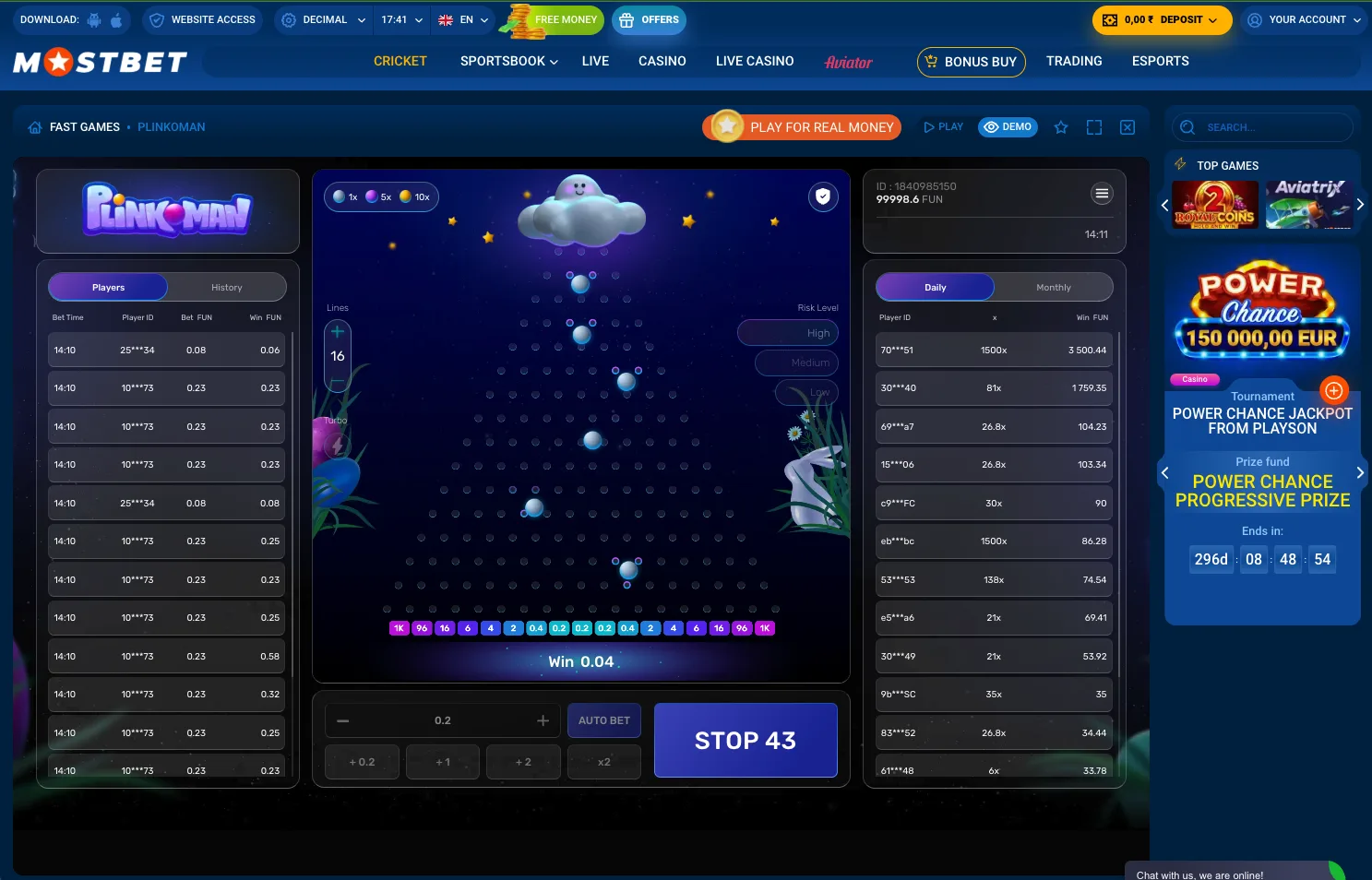
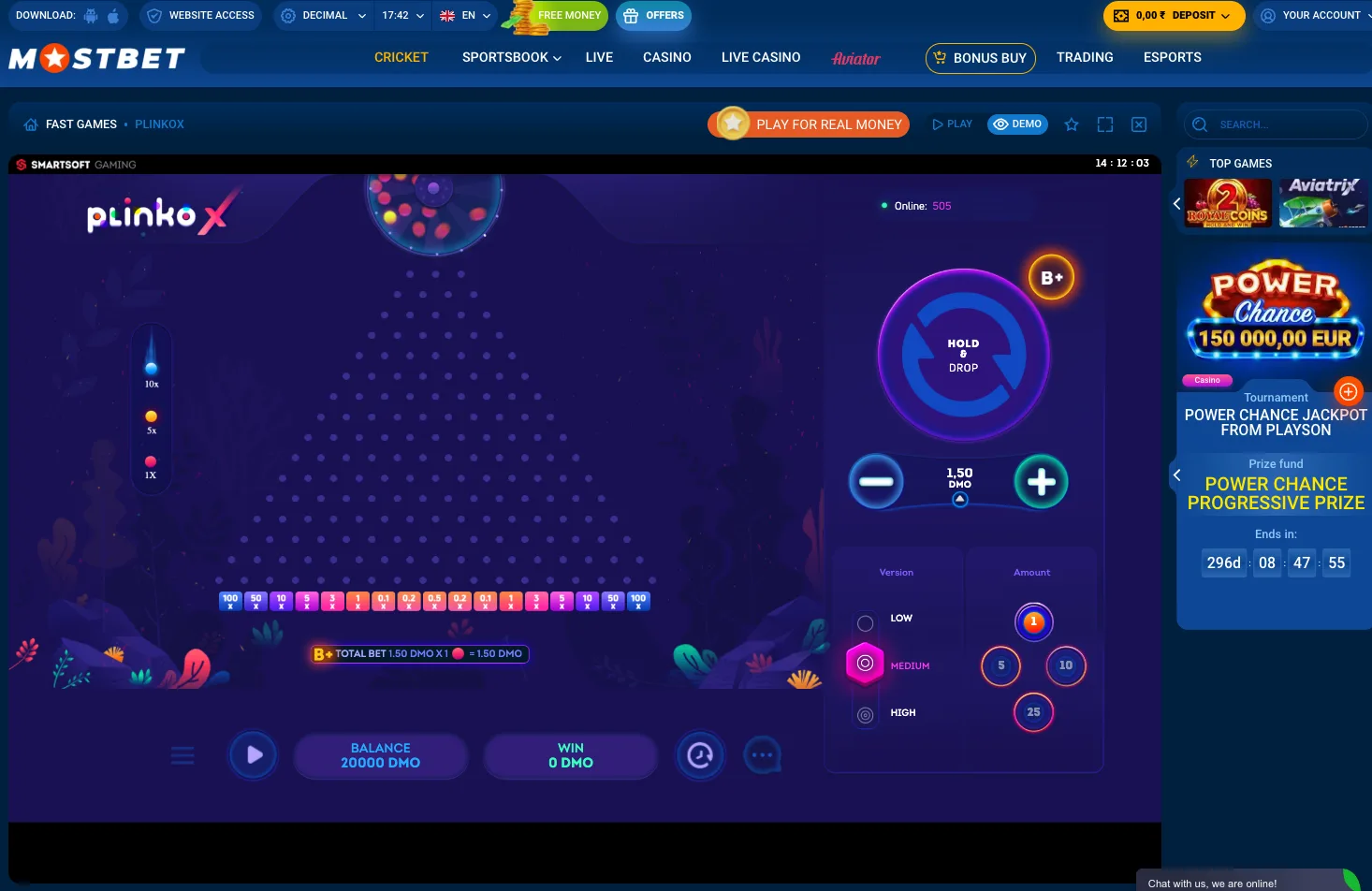
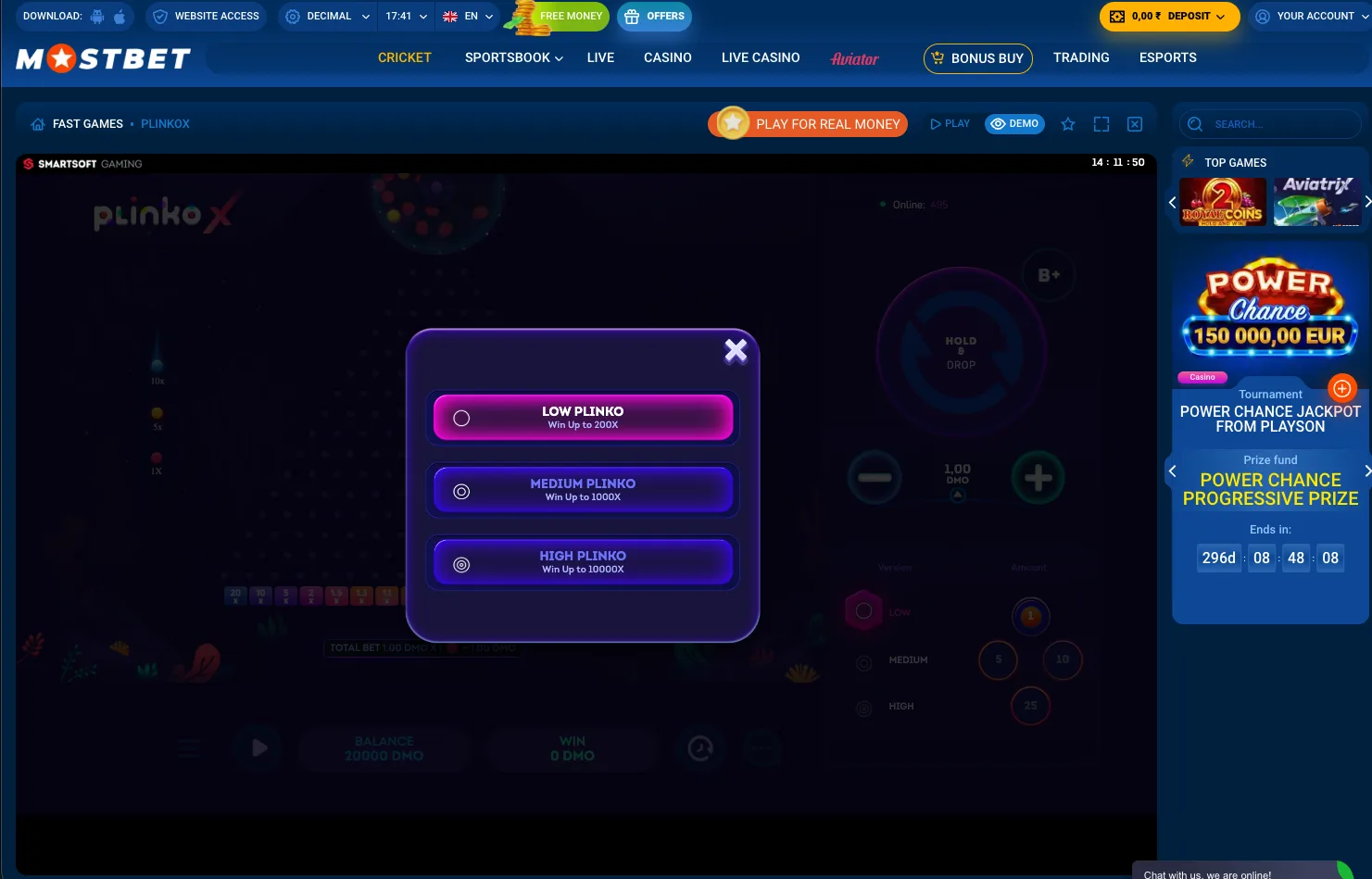
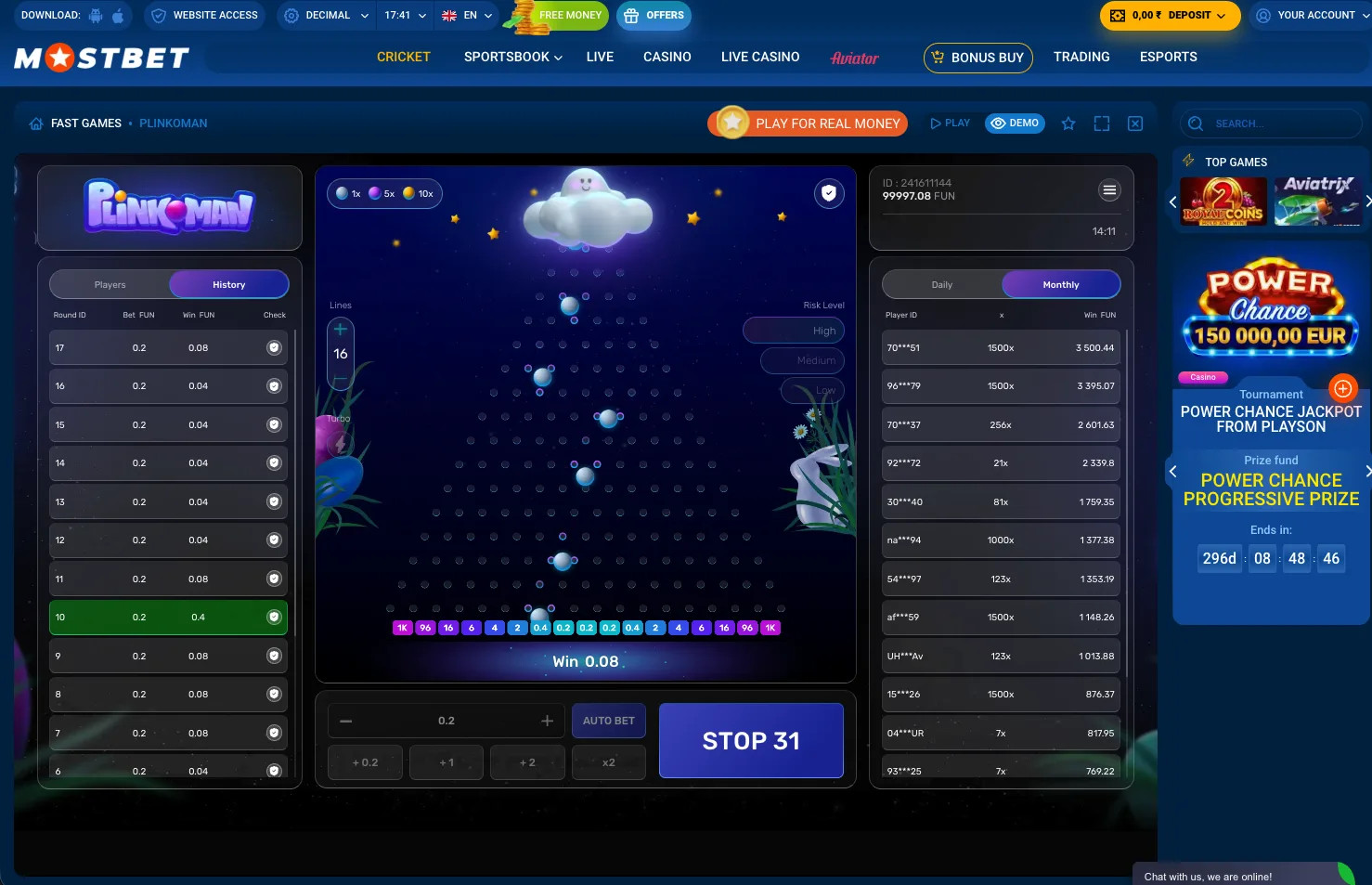
Table of Contents
- What Is Plinko on Mostbet?
- How Plinko Works: The Mechanics
- Risk Levels Explained: Low, Medium, High
- Row Count Comparison: 8 to 16 Rows
- Session Data: 10 Real Drops With Results
- Multiplier Distribution Tables
- Provably Fair: How Verification Works
- Getting Started on Mostbet
- Tips From Hundreds of Drops
- Responsible Gambling
- Frequently Asked Questions
What Is Plinko on Mostbet?
If you have ever watched a game show where a disc bounces down a pegged board and lands in a prize slot at the bottom, you already understand Plinko. The version on Mostbet takes that same concept and turns it into an instant casino game with real multipliers, adjustable risk, and provably fair outcomes.
I first tried Plinko about two years ago when I was looking for something simpler than crash games. I love fast-paced instant games, but crash games always stressed me out with the timing element. Do I cash out now? Did I wait too long? Plinko removes all of that. You set your risk level, choose your row count, drop the ball, and watch. The entire outcome takes about two seconds. No timing pressure. No skill element. Just a ball bouncing off pegs in a way that feels satisfyingly random.
The game is made by Spribe, the same studio behind Aviator. There is also a BGaming version available on some platforms, but the Spribe version is the one I play on Mostbet and the one this guide focuses on. The core mechanic is identical across versions—the differences are cosmetic and in the specific multiplier values.
Here is the basic setup. You see a triangular pegboard on screen. Pegs are arranged in rows. At the top, there is a single drop point. At the bottom, there are multiplier slots. The number of slots equals the number of rows plus one. So 8 rows gives you 9 slots, 16 rows gives you 17 slots. The ball drops from the top, bounces left or right off each peg it hits, and eventually lands in one of those bottom slots. Each slot has a multiplier that gets applied to your bet.
The outer slots have the highest multipliers. The center slots have the lowest. On High risk with 16 rows, the outermost slot pays 1000x while the center slot pays 0.2x. On Low risk with the same rows, the outer slot might only pay 16x but the center slots pay 0.5x instead of 0.2x. That trade-off between maximum potential and minimum floor is the entire strategic decision in Plinko.
What makes Plinko special compared to other instant games? Honestly, it is the simplicity. There is exactly one decision to make before each drop: risk level and row count. After that, it is pure luck. No cashout timing, no multiplier watching, no second-guessing. You drop the ball and see what happens. For someone like me who tends to overthink gambling decisions, that forced simplicity is actually a feature.
Plinko at a Glance
| Feature | Details |
|---|---|
| Game Provider | Spribe |
| Game Type | Instant / Casual |
| RTP Range | 96% – 99% |
| Risk Levels | Low, Medium, High |
| Row Options | 8, 9, 10, 11, 12, 13, 14, 15, 16 |
| Max Multiplier | 1000x (High, 16 rows) |
| Min Bet | $0.10 USD (or equivalent) |
| Provably Fair | Yes |
| Auto-Play | Yes |
How Plinko Works: The Mechanics
Let me walk through exactly what happens when you drop a Plinko ball. Understanding the mechanics helps you make informed decisions about risk levels and row counts.
The Pegboard Physics
The pegboard is a triangle of evenly spaced pegs. When the ball hits a peg, it goes either left or right. Each direction has a roughly 50/50 probability. The ball hits one peg per row, so an 8-row board means 8 bounces, and a 16-row board means 16 bounces.
Because each bounce is essentially a coin flip, the ball follows a binomial distribution. Most of the time, the ball ends up somewhere near the center because going left roughly half the time and right roughly half the time averages out to the middle. To land in the outermost slot, the ball needs to go the same direction on every single bounce. On 16 rows, that is 16 consecutive same-direction bounces. The probability of that is roughly 1 in 65,536 drops. That is why the outer multipliers are so high—they almost never hit.
This is not just theory. In my 500+ drops, I never once hit the outermost slot on a 16-row High risk game. Not once. The highest multiplier I landed on 16-row High was 170x, which was the second slot from the edge. Still a fantastic result, but 1000x remains something I have only seen in screenshots.
The Three Risk Levels
Risk level changes the multiplier values assigned to each slot. The pegboard and ball physics stay exactly the same. The ball has the same probability of landing in any given slot regardless of risk level. What changes is the payout when it lands there.
- Low Risk: Flattened multiplier curve. Center slots pay close to 1x (typically 0.5x to 1.0x), outer slots pay modest multipliers (5x to 16x depending on rows). You lose less on center hits and win less on edge hits. Longest sessions, most predictable.
- Medium Risk: Moderate curve. Center slots drop to around 0.3x to 0.4x, outer slots reach 18x to 110x. More variance than Low, more excitement, but you will see your balance dip more frequently.
- High Risk: Extreme curve. Center slots pay as low as 0.2x (losing 80% of your bet), but outer slots can reach 29x, 170x, or even 1000x on 16 rows. This is the boom-or-bust mode. Most drops result in losses, but a single lucky edge hit can pay for the entire session.
Row Count: More Rows, More Extreme
More rows means more pegs, more bounces, and more multiplier slots. The effect is two-fold. First, adding rows increases the maximum possible multiplier because the probability of hitting the extreme edges decreases with more bounces. Second, adding rows makes the center slots slightly worse because the multiplier values are redistributed.
I think of it this way: 8 rows is a gentle game with modest payouts. 16 rows is the full Plinko experience with dramatic highs and frustrating lows. Most of my play is at 12 or 14 rows—enough variety in the outcomes to keep things interesting without the multiplier extremes that require thousands of drops to see.
For a complete row-by-row breakdown with multiplier tables, check the risk levels deep dive.
Risk Levels Explained: Low, Medium, High
This is the core decision in Plinko, and it is worth understanding properly. I played 150+ drops on each risk level at 12 rows to compare them side by side. Here is what I found.
Low Risk at 12 Rows
Low risk at 12 rows has 13 multiplier slots. The distribution looks like this:
| Slot Position | Multiplier | Approximate Hit Rate |
|---|---|---|
| Outer (1st) | 8.9x | ~0.02% |
| 2nd | 3x | ~0.3% |
| 3rd | 1.6x | ~1.6% |
| 4th | 1.4x | ~5.4% |
| 5th | 1.1x | ~12.1% |
| 6th | 1x | ~19.3% |
| Center (7th) | 0.5x | ~22.6% |
Table is symmetric—only showing one half. The other side mirrors these values.
In my 170 Low risk drops at 12 rows, my balance fluctuated gently. I started at $100, went as low as $91, peaked at $108, and ended at $97. The experience felt more like entertainment than gambling. Most drops returned between 0.5x and 1.4x, with the occasional 3x or 8.9x to keep things fun. I would describe the vibe as "relaxed but not boring." If you want to play Plinko for an hour without your bankroll disappearing, Low risk is the way.
Medium Risk at 12 Rows
| Slot Position | Multiplier | Approximate Hit Rate |
|---|---|---|
| Outer (1st) | 33x | ~0.02% |
| 2nd | 11x | ~0.3% |
| 3rd | 4x | ~1.6% |
| 4th | 2x | ~5.4% |
| 5th | 0.6x | ~12.1% |
| 6th | 0.3x | ~19.3% |
| Center (7th) | 0.3x | ~22.6% |
Table is symmetric.
Medium risk is where Plinko starts to feel like proper gambling. In my 160 drops, I started at $100, crashed down to $64 at one point, then a lucky 11x hit brought me back to $89. Ended the session at $78. The center slots paying 0.3x means most drops eat 70% of your bet. But when you hit 4x or above, the dopamine hit is real. Medium risk is my personal favorite for regular play because it has that nice tension without the brutal variance of High.
High Risk at 12 Rows
| Slot Position | Multiplier | Approximate Hit Rate |
|---|---|---|
| Outer (1st) | 141x | ~0.02% |
| 2nd | 25x | ~0.3% |
| 3rd | 8.4x | ~1.6% |
| 4th | 3x | ~5.4% |
| 5th | 0.5x | ~12.1% |
| 6th | 0.2x | ~19.3% |
| Center (7th) | 0.2x | ~22.6% |
Table is symmetric.
High risk is a wild ride. In 180 drops at $1 per drop, I spent $180 total. My returns: $143. A net loss of $37, or about 20% of my wagers. But the experience was anything but linear. I went through a stretch of 23 drops where every single ball landed in the 0.2x or 0.5x slots. That is $23 wagered, $6.10 returned. Brutal. Then drop #24 hit the 25x slot. One drop returned $25 and suddenly the session felt alive again. That emotional rollercoaster is what High risk is all about.
I would not recommend High risk to anyone with a small bankroll. You need at least 200 drops worth of funds to survive the dry spells. And you need the emotional discipline to not rage-bet bigger after a string of 0.2x hits. For the full risk level analysis, see the dedicated risk levels page.
Row Count Comparison: 8 to 16 Rows
More rows equals more volatility. Here is a side-by-side comparison of the key metrics across common row counts, all at Medium risk.
| Rows | Total Slots | Max Multiplier | Center Multiplier | Volatility | My Take |
|---|---|---|---|---|---|
| 8 | 9 | 13x | 0.4x | Low-Medium | Good for beginners |
| 10 | 11 | 22x | 0.4x | Medium | Balanced gameplay |
| 12 | 13 | 33x | 0.3x | Medium | My sweet spot |
| 14 | 15 | 56x | 0.2x | Medium-High | Exciting with patience |
| 16 | 17 | 110x | 0.2x | High | Jackpot chasers only |
Notice how the max multiplier scales dramatically while the center multiplier gets worse. Going from 8 to 16 rows nearly 10x's the maximum payout but also means your average drop returns less. The ball has more room to drift toward the center with more rows, making edge hits exponentially rarer.
My recommendation: start at 8 or 10 rows to learn the game. Move to 12 rows once you are comfortable. Only go to 14 or 16 rows if you specifically want high-variance sessions and have the bankroll to support extended losing streaks.
Session Data: 10 Real Drops With Results
Here is a sample of 10 consecutive drops I recorded during a Medium risk, 12-row session on April 3, 2026. Bet size was $1.00 per drop.
| Drop # | Risk | Rows | Slot Hit | Multiplier | Payout | Running P&L |
|---|---|---|---|---|---|---|
| 1 | Medium | 12 | 6th (center area) | 0.3x | $0.30 | -$0.70 |
| 2 | Medium | 12 | 5th | 0.6x | $0.60 | -$1.10 |
| 3 | Medium | 12 | 4th | 2x | $2.00 | -$0.10 |
| 4 | Medium | 12 | Center (7th) | 0.3x | $0.30 | -$0.80 |
| 5 | Medium | 12 | Center (7th) | 0.3x | $0.30 | -$1.50 |
| 6 | Medium | 12 | 5th | 0.6x | $0.60 | -$1.90 |
| 7 | Medium | 12 | 3rd | 4x | $4.00 | +$1.10 |
| 8 | Medium | 12 | 5th | 0.6x | $0.60 | +$0.70 |
| 9 | Medium | 12 | 6th | 0.3x | $0.30 | +$0.00 |
| 10 | Medium | 12 | 4th | 2x | $2.00 | +$1.00 |
Real data from personal session. Bet: $1.00 per drop. April 3, 2026.
A few observations from this sample. Seven out of ten drops returned less than 1x. That is typical for Medium risk—the majority of your drops will be partial losses. But drop #7 hitting 4x and drop #3 hitting 2x were enough to keep the session roughly break-even. This is the Plinko pattern: small losses interrupted by occasional spikes that bring you back. Whether you end up positive or negative over a longer session depends almost entirely on how often those spikes happen, which is pure luck.
In my extended session of 160 Medium risk drops, 68% of drops returned less than 1x. But 11% returned 2x or higher, and 2.5% returned 4x or higher. Those 2.5% of drops accounted for about 35% of my total returns. Plinko is not a game of steady wins. It is a game of patient waiting punctuated by satisfying payoffs.
Multiplier Distribution Tables
These tables show the multiplier values for each slot position at the three risk levels on a 12-row board. The distribution is symmetric, so I show the full layout from left to right.
12-Row Board: All Three Risk Levels
| Slot | Low Risk | Medium Risk | High Risk |
|---|---|---|---|
| 1 (Far Left) | 8.9x | 33x | 141x |
| 2 | 3x | 11x | 25x |
| 3 | 1.6x | 4x | 8.4x |
| 4 | 1.4x | 2x | 3x |
| 5 | 1.1x | 0.6x | 0.5x |
| 6 | 1x | 0.3x | 0.2x |
| 7 (Center) | 0.5x | 0.3x | 0.2x |
| 8 | 1x | 0.3x | 0.2x |
| 9 | 1.1x | 0.6x | 0.5x |
| 10 | 1.4x | 2x | 3x |
| 11 | 1.6x | 4x | 8.4x |
| 12 | 3x | 11x | 25x |
| 13 (Far Right) | 8.9x | 33x | 141x |
Look at the contrast. On Low risk, even the worst slot (center at 0.5x) only loses half your bet. On High risk, the three center slots all pay 0.2x—losing 80% of your bet. But Low risk caps at 8.9x while High risk can hit 141x. Same board, same ball physics, completely different risk profile.
High Risk Multipliers by Row Count
| Rows | Max Multiplier | 2nd Best | Center (Worst) | Breakeven Slots |
|---|---|---|---|---|
| 8 | 29x | 7.1x | 0.2x | 2 of 9 |
| 10 | 76x | 14x | 0.2x | 2 of 11 |
| 12 | 141x | 25x | 0.2x | 2 of 13 |
| 14 | 420x | 56x | 0.2x | 2 of 15 |
| 16 | 1000x | 170x | 0.2x | 2 of 17 |
That 1000x on 16-row High risk is the dream. But notice the "Breakeven Slots" column. On 16-row High, only 2 out of 17 slots pay 1x or better. The other 15 slots all lose you money on every drop. You are fighting brutal odds for that one glorious hit. Is it fun? Absolutely. Is it smart? Depends on your bankroll and tolerance for watching your balance shrink.
For the complete multiplier tables for every row count and risk combination, visit the risk levels page.
Provably Fair: How Verification Works
One of the best things about Plinko on Mostbet is that it is provably fair. This means you can mathematically verify that the game did not cheat on any individual drop. Here is how it works in simple terms.
Before you even place your bet, the server generates a seed (a long string of random characters). This seed, combined with a client seed (which you can set yourself) and a nonce (a counter that increases with each bet), determines the ball's path through the pegs. The result is locked in before your bet is placed.
After the round, you can see the server seed and verify the result yourself using the game's built-in verification tool. If the math does not match up, the game cheated. In my three years of playing Spribe games, I have verified dozens of rounds and never found a discrepancy. The system works.
Why does this matter? Because it means Plinko cannot be rigged on a per-player or per-bet basis. The game cannot decide "this player is winning too much, let me give them worse results." The outcome is cryptographically locked before the bet exists. That is a level of transparency that traditional slot machines simply cannot offer.
Some players confuse "provably fair" with "fair." Let me be clear: the house still has an edge. The multiplier values are set so that the expected value of each drop is slightly less than your bet amount. On Low risk, the expected return is about 99 cents per dollar wagered. On High risk, it is about 96 cents. Provably fair means the game operates exactly as designed, not that you will win.
Getting Started on Mostbet
If you want to try Plinko yourself, here is the quick-start version. For the detailed walkthrough, visit the how to play Plinko page.
- Create an account on Mostbet. Takes about two minutes. You need an email or phone number. Verification may be required depending on your country.
- Make a deposit. Mostbet supports bank cards, e-wallets, and cryptocurrency. Minimum deposit varies by method but starts around $1-5 USD or equivalent.
- Navigate to Plinko. Go to the Casino section, search for "Plinko," or look under Instant Games or Spribe games. You should see the Spribe Plinko tile.
- Set your risk level to Low and rows to 8. Start with the gentlest settings. Set bet size to the minimum ($0.10 or equivalent).
- Drop 20 balls and just watch. Get a feel for the game speed, the ball physics, the multiplier distribution. Do not chase big numbers yet. Just observe.
First-Timer Settings I Recommend
After your initial 20 drops on Low/8-rows, try these progressions:
- Session 2: Low risk, 12 rows. Same minimum bet. Notice how the multiplier range expands.
- Session 3: Medium risk, 12 rows. You will start seeing 0.3x center hits and feel the difference. Keep bet sizes small.
- Session 4: If you enjoyed Medium, try High risk at 8 rows. The reduced row count keeps volatility somewhat manageable while giving you a taste of the bigger multipliers.
Do not jump straight to High risk, 16 rows. I made that mistake when I first started. Watched my $20 bankroll evaporate in about 40 drops because I was hitting 0.2x over and over. It was not fun—it was frustrating. Build up to the high-variance settings gradually.
Tips From Hundreds of Drops
After three years of playing Plinko across various platforms and hundreds of sessions on Mostbet specifically, here is what I have actually learned. Not recycled "tips" from other sites—actual lessons from my own play.
Bankroll Management for Plinko
Plinko eats bankroll differently depending on risk level. On Low risk, your bankroll erodes slowly. Think of it like a shallow slope. On High risk, your bankroll can crater in a handful of drops. Here are my personal guidelines:
- Low risk: Budget for 100+ drops. If your bankroll is $20, bet $0.10 to $0.20 per drop.
- Medium risk: Budget for 150+ drops. The higher variance means you need more runway for recovery. Same $20 bankroll, bet $0.10.
- High risk: Budget for 200+ drops minimum. Seriously. High risk Plinko can have losing streaks of 30+ drops where every ball hits the center zone. $20 bankroll means $0.10 bets, no exceptions.
The single biggest mistake I see in Plinko is bet sizing. Players set High risk at 16 rows, bet 5% of their bankroll per drop, and then act surprised when 20 consecutive 0.2x hits wipe out 80% of their funds. The math is not complicated. 0.2x times 20 drops at 5% bankroll each means you have lost 80% of your starting balance. Have enough drops in your budget to survive the streaks.
Auto-Play vs Manual Drops
Plinko has an auto-play feature that lets you set a number of drops and let them run automatically. I use auto-play for about 70% of my Plinko sessions. Here is why.
When I drop manually, I tend to second-guess my settings after every loss. "Maybe I should switch to Low risk." "Maybe I should try 16 rows." "Maybe I should increase my bet to win it back." Auto-play removes that temptation. I set my parameters, set 50 or 100 drops, and let it run. The results end up being virtually identical to manual play (because the game is purely random), but my emotional state is much better. I am watching a show instead of making anxious decisions every three seconds.
The one time I do not use auto-play: when I am playing High risk with larger bets. In those sessions, I want to feel each drop individually and I want the option to stop at any time if my bankroll hits a threshold. Auto-play at High risk with significant bets can drain your balance before you realize what happened.
The Spribe Version vs BGaming
If you see two Plinko games on Mostbet, they might be from different providers. The Spribe version is the one I recommend and the one I base this guide on. The BGaming version has slightly different multiplier values and a different visual style, but the core concept is identical. The main differences:
- Spribe allows more row options (8-16 in increments of 1). BGaming typically offers fewer options.
- Multiplier values differ slightly between providers.
- Both are provably fair.
- Visual style: Spribe is more minimal and clean. BGaming tends to be more colorful.
For a detailed comparison, check the full Plinko review.
Responsible Gambling
I genuinely enjoy Plinko. It is one of my favorite casual casino games. But I would be irresponsible if I did not say this clearly: Plinko is gambling. The house has an edge on every single drop. Over the long run, you will lose money. The only question is how much entertainment you get for that cost.
Think of your Plinko bankroll as an entertainment budget, the same way you would budget for a movie or a night out. When it is gone, it is gone. Do not deposit more. Do not chase losses. Do not convince yourself that the next drop will be the big one. The game does not know or care about your previous results.
Set deposit limits on your Mostbet account. Use the session timer feature. Take breaks. If you ever feel like you need to play, that is a sign to stop. Gambling should be something you choose to do for fun, not something you feel compelled to do.
For more resources, visit our responsible gambling page or contact BeGambleAware.org.
Gambling involves risk. Plinko is a game of pure chance with a house edge. Never bet more than you can afford to lose. Set deposit limits, use session timers, and take breaks. If you or someone you know has a gambling problem, visit BeGambleAware.org. You must be 18+ to gamble. 18+
Frequently Asked Questions
Quick answers to common Plinko questions. For the extended FAQ with 15+ questions, visit the FAQ page.
What is Plinko on Mostbet?
Plinko is an instant casino game on Mostbet where you drop a ball from the top of a triangular pegboard. The ball bounces off pegs and lands in a multiplier slot at the bottom. You choose the risk level (Low, Medium, or High) and the number of rows (8 to 16), which determine the available multipliers. It is made by Spribe and is provably fair.
What is the RTP of Plinko on Mostbet?
The RTP varies by risk level. Low risk has an RTP of approximately 99%, meaning the house edge is only about 1%. Medium risk is around 97-98%, and High risk is approximately 96%. Higher risk means higher potential multipliers but also a larger house edge.
Can you predict where the Plinko ball will land?
No. Each drop uses a provably fair random number generator. The ball path is determined by a cryptographic seed generated before the drop happens. There is no pattern, no prediction tool, and no hack. Anyone selling a Plinko predictor is scamming you.
What is the best risk level for Plinko?
It depends on your goals. Low risk gives frequent small wins and the longest sessions per bankroll. High risk offers the biggest multipliers (up to 1000x on 16 rows) but you will hit 0.2x center slots very often. Medium risk is a balanced middle ground. I personally play Medium risk most of the time.
Is Plinko on Mostbet provably fair?
Yes. Plinko by Spribe uses a provably fair system with cryptographic seeds. Each drop result is generated before you place your bet. You can verify any past result using the verification tool built into the game interface. I have verified dozens of results and never found an issue.