Plinko vs Mines: Which Mostbet Instant Game Is Right for You?

Last updated: April 7, 2026
This article contains affiliate links. See our disclosure.
Plinko and Mines are two of the most popular instant games on Mostbet. Both are made by Spribe, both are provably fair, and both attract players who want fast-paced gambling without the complexity of traditional casino games. But they play very differently.
I have spent hundreds of hours playing both games. Plinko is my primary game—it is what this entire site is built around—but I have also logged plenty of Mines sessions to give a fair comparison. This guide breaks down exactly how the two games differ and helps you decide which one fits your play style.
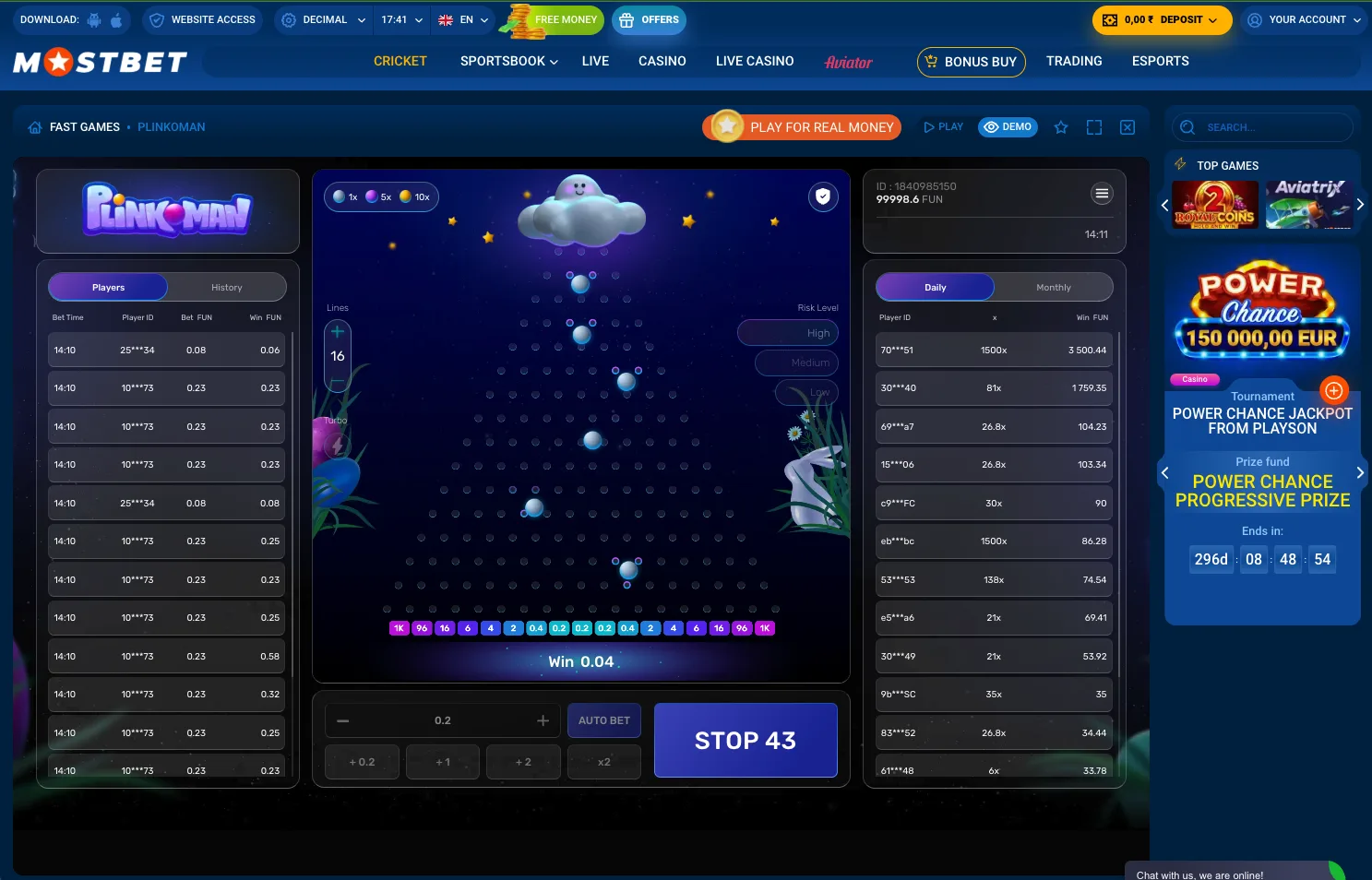

Table of Contents
Quick Comparison Table
Here is a side-by-side overview of the key features. I will break down each category in detail below.
| Feature | Plinko | Mines |
|---|---|---|
| Provider | Spribe | Spribe |
| Game Type | Instant / Passive | Instant / Interactive |
| RTP | 96% – 99% | 97% (approx.) |
| Player Decisions | Risk level + rows (before drop) | Which tile to reveal (during game) |
| Skill Element | None—pure luck | Partial—cashout timing |
| Max Multiplier | 1000x (High, 16 rows) | Unlimited (scales with mines) |
| Round Duration | ~2 seconds | Player-controlled (10s – 5 min) |
| Volatility Range | Low to Extreme | Low to Extreme |
| Auto-Play | Yes | No |
| Provably Fair | Yes | Yes |
| Emotional Intensity | Low to Moderate | Moderate to High |
| Session Length Control | Easy (set-and-forget) | Harder (each round requires decisions) |
How Each Game Works
Plinko: Drop and Watch
In Plinko, you select a risk level (Low, Medium, or High), choose a row count (8 to 16 rows), set your bet amount, and drop a ball. The ball bounces down a triangular pegboard, hitting pegs with a roughly 50/50 left-right probability at each level. It lands in a multiplier slot at the bottom. Your bet is multiplied by whatever slot it lands in. The entire process takes about two seconds and requires no input after the initial settings.
The critical point: after you click "drop," you have zero control over the outcome. Plinko is a fully passive game. You watch the ball bounce and accept the result. That is both its greatest strength and its greatest limitation.
Mines: Reveal and Decide
Mines presents you with a 5x5 grid of 25 hidden tiles. Before starting, you choose how many mines (1 to 24) to place on the board. More mines means higher multipliers for each safe tile revealed but a greater chance of hitting a mine and losing everything. Once the round starts, you click tiles one at a time. Each safe tile increases your multiplier. You can cash out at any point. If you hit a mine, you lose your entire bet for that round.
The critical difference: you make decisions during the game. Every tile click is a choice—keep going for a higher multiplier or cash out with what you have. That decision-making element makes Mines fundamentally different from Plinko.
RTP Comparison
Return to Player (RTP) measures the percentage of wagered money that a game returns to players over time. A higher RTP means a lower house edge.
| Game / Setting | Approximate RTP | House Edge |
|---|---|---|
| Plinko — Low Risk | ~99% | ~1% |
| Plinko — Medium Risk | ~97–98% | ~2–3% |
| Plinko — High Risk | ~96% | ~4% |
| Mines (optimal cashout) | ~97% | ~3% |
Plinko on Low risk has one of the best RTPs you will find in any instant casino game. The 99% RTP means the house takes only about 1% of your wagered amount over time. That is comparable to blackjack played with basic strategy. However, this comes with very low multipliers and minimal excitement.
Mines has a relatively fixed RTP regardless of mine count—the house edge is built into the multiplier values for each tile reveal. Whether you play with 1 mine or 24 mines, the mathematical edge is similar. The difference is in variance, not edge.
Key takeaway: If minimizing losses is your priority, Plinko on Low risk gives you the best mathematical return. If you want more engagement and accept a slightly higher house edge, Mines or Plinko on Medium/High risk are comparable.
Variance and Volatility
Variance describes how much your results swing above and below the expected return. High variance means big swings—long losing streaks followed by large wins. Low variance means steady, predictable results close to the expected RTP.
Plinko Variance by Risk Level
- Low Risk: Very low variance. Most drops return 0.5x to 1.6x. Rare big wins (5x-16x on edge slots). Your balance graph looks like a gentle downward slope with small bumps.
- Medium Risk: Moderate variance. Drops commonly return 0.3x to 1.8x with occasional 18x-110x hits. More pronounced hills and valleys in your balance.
- High Risk: Extreme variance. Most drops return 0.2x to 0.6x (net loss), but edge hits can return 29x, 170x, or even 1000x. Your balance graph looks like a steep decline punctuated by rare, sharp spikes.
Mines Variance by Mine Count
- 1-3 mines: Low variance if you cash out early. Each safe tile gives a small multiplier bump. Low risk of hitting a mine per click.
- 5-10 mines: Moderate variance. Meaningful multipliers after 3-5 safe reveals but a real chance of hitting a mine on each click.
- 15-24 mines: Extreme variance. Even a single safe tile reveal gives a large multiplier, but the odds of hitting a mine are overwhelming. Most rounds end in total loss.
Both games can be tuned from low to extreme variance. The difference is that Plinko's variance is set before the round begins and cannot be changed mid-drop, while Mines variance is dynamic—you can always cash out and reduce your risk during the round.
Skill Element: The Key Difference
This is the single biggest distinction between these two games, and it matters more than most comparisons acknowledge.
Plinko: Zero Skill
Plinko has no skill component whatsoever. Once you set your risk level and row count, the outcome is entirely determined by the provably fair random number generator. There is no decision you can make during the drop that affects the result. No timing. No pattern recognition. No strategy beyond choosing your settings. A perfectly optimal Plinko player and a complete beginner will have identical expected results over time.
For some people, this is a feature. No skill means no mistakes. You cannot beat yourself up for cashing out too early or too late. The game is pure entertainment with a known cost structure.
Mines: Partial Skill (Cashout Timing)
Mines introduces a genuine skill element: knowing when to cash out. While you cannot predict where the mines are (the layout is provably fair and random), you do control when to stop clicking tiles. This is functionally identical to the decision in crash games—when to take your profit versus when to push for more.
The skilled Mines player understands the odds for each additional tile click given the number of mines and revealed tiles, and makes rational cashout decisions based on those odds. The unskilled player clicks randomly and either cashes out based on gut feeling or pushes too far on a streak. Over thousands of rounds, the disciplined player will have better results—not because they beat the house edge, but because they avoid catastrophic cashout mistakes.
However, this skill element is a double-edged sword. It creates the illusion of control, which can lead to overconfidence. "I am good at Mines" can become a dangerous belief that leads to larger bets and longer sessions. In Plinko, there is no illusion of control—you drop a ball and watch. That honesty can be psychologically healthier.
Session Experience
Beyond the math, these games feel completely different to play. Here is what a typical session looks like for each:
A Plinko Session
You set your risk level and row count. You choose your bet. You drop balls. Maybe you use auto-play to drop 50 balls in rapid succession. You watch the balls bounce and land. There are moments of excitement when a ball drifts toward an edge slot, and moments of mild disappointment when it settles in the center again. The pace is fast. A 100-drop session takes about four to five minutes. When it is over, you check your balance, compare it to your starting point, and decide whether to play another session or stop.
Plinko sessions are low-stress and low-engagement. You can play while watching television or listening to a podcast. The emotional intensity is low because you have no control over each result. This makes it easier to stick to time and money limits.
A Mines Session
You set the mine count and bet. You stare at a grid of 25 tiles. You click one. Safe. The multiplier increases. You click another. Safe. The tension builds. Should you cash out at 2.5x or push for 4x? You click again. Safe. The multiplier is now 4.2x. One more click could bring it to 7x, but there are mines out there. Your heart rate increases. You click. Mine. Everything is gone. You feel the loss physically. You bet again. This time you cash out early at 1.8x, feeling cautious after the loss. The next round you push further. The cycle of tension and release continues.
Mines sessions are high-engagement and emotionally intense. Each click is a micro-decision that carries real consequences. This makes Mines more exciting but also more draining and harder to walk away from. The constant decision-making can lead to longer sessions than intended.
| Session Aspect | Plinko | Mines |
|---|---|---|
| Pace | Very fast (2s per round) | Player-controlled (varies) |
| Mental Energy Required | Low | Moderate to High |
| Ease of Stopping | Easy—no pending decisions | Harder—mid-round tension |
| Tilt Risk | Lower—no skill to second-guess | Higher—bad cashout decisions sting |
| Multi-tasking Friendly | Yes (especially with auto-play) | No (requires focus each round) |
Who Should Play Which Game?
Choose Plinko If You...
- Want a passive, low-stress gambling experience
- Prefer not to make decisions during gameplay
- Like to set limits and walk away without temptation
- Enjoy watching randomness play out (the visual appeal of bouncing balls)
- Want to use auto-play for hands-off sessions
- Prioritize the highest possible RTP (Low risk Plinko at ~99%)
- Tend to make impulsive decisions under pressure
Choose Mines If You...
- Want an interactive, engaging experience
- Enjoy the tension of risk-reward decisions
- Like having some control over the outcome (cashout timing)
- Prefer slower, more deliberate gameplay
- Are disciplined enough to cash out at rational points
- Enjoy the psychological challenge of knowing when to stop
- Do not mind higher emotional intensity during sessions
Final Verdict
Neither game is objectively better than the other. They serve different player needs. Plinko is the game I play more often because I value its simplicity and the ease with which I can control my sessions. I set my limits, drop my balls, and walk away. There is no "one more click" temptation because there are no clicks to make.
Mines is the game I play when I want engagement and excitement. The tension of each tile reveal, the satisfaction of a well-timed cashout, and the drama of a mine hit create a more intense experience. But that intensity comes with a cost: I find it harder to stick to my limits during Mines sessions.
My recommendation: try both with minimum bets and see which one fits your personality. If you are the kind of person who can walk away from a poker table mid-hand, Mines will suit you. If you prefer to know exactly what you are in for before you commit, Plinko is your game.
Gambling involves risk. Both Plinko and Mines have a house edge. You will lose money over time. Set limits before you play and stick to them. If gambling becomes a problem, visit BeGambleAware.org. 18+